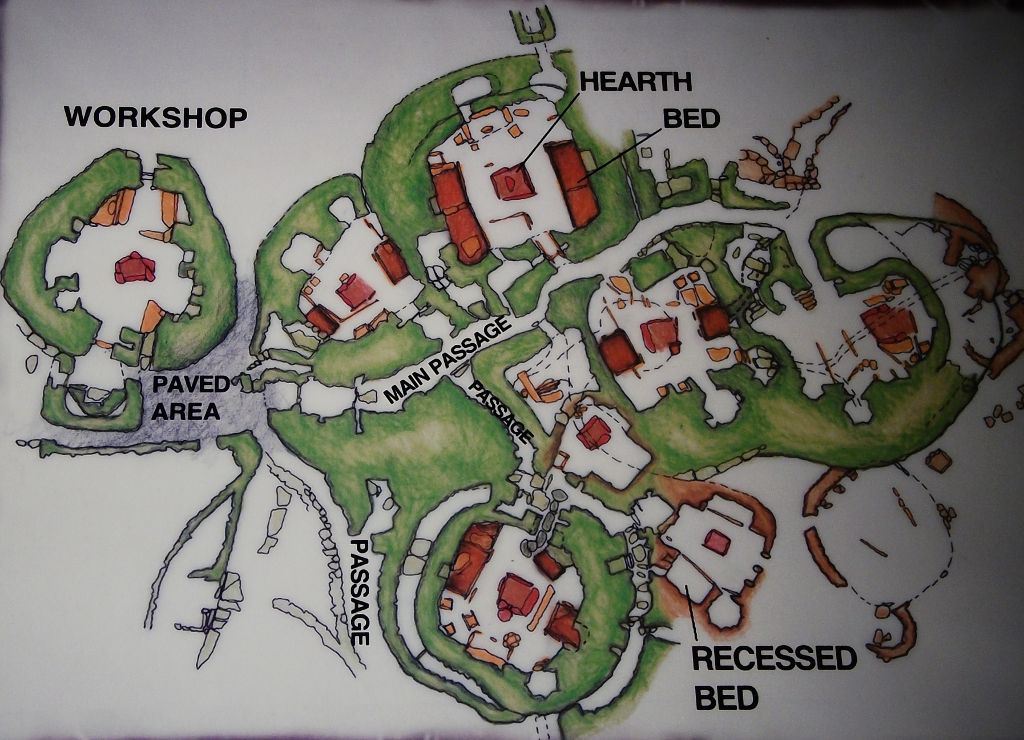
Source one: Drawing of village layout of Skara Brae, showing the passages between the sheltered huts.
Archaeologists have uncovered eight huts in Skara Brae and it is estimated that they were home to between fifty and one hundred villagers. Each hut measures between four to six meters across.
Source One shows that there were a series of paths that wove through the village. There was a main passage cutting through the centre of the village. The village was built buried into the ground but with paths exposed to the outside world.
There are no traces of the original roofs, only the walls remain of the individual huts.
Every hut was identical except for house seven and house eight. Nobody knows why house seven was built. The door on this hut could only be opened from the outside. Perhaps it was used as a prison, or to isolate young boys or girls that were approaching puberty as part of a ceremony. Maybe it was a birthplace?
House eight was separate to the other huts in Skara Brae, and had none of the furnishings or other objects as the common hut would. Archaeologists mention that it may have been a workshop to manufacture or build tools, as they found flint and other stone debris.
Another theory for why house eight was built is that it could have been a meeting house for the public, as there were many carved stone decorations.
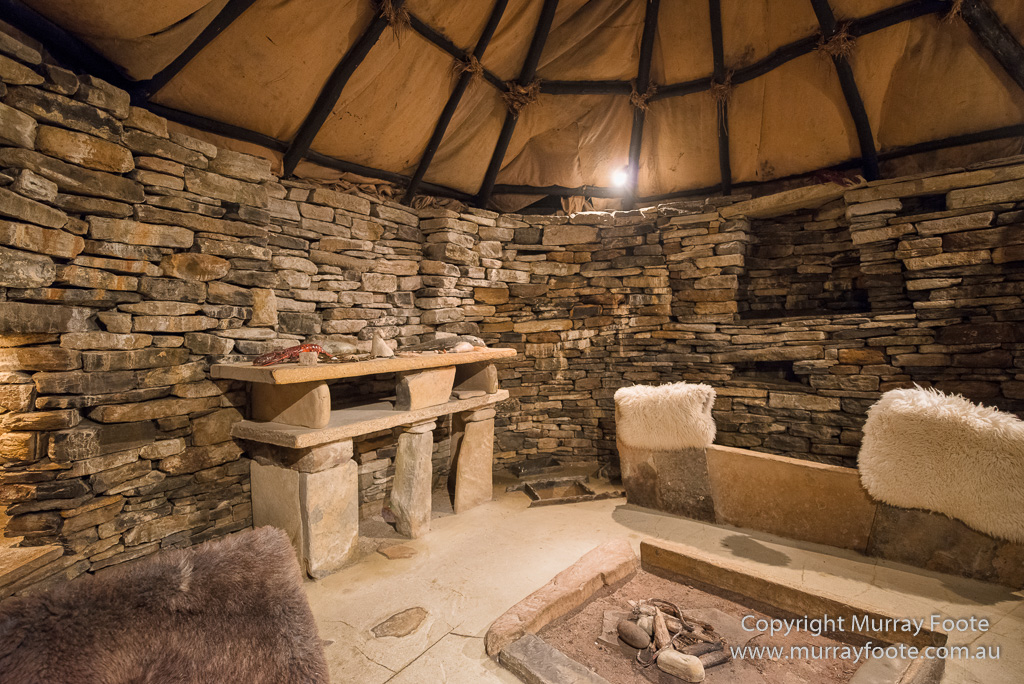
Source Two: Inside of one of the common huts built into the ground, showing the central hearth.
Apart from hut seven and eight, there was an identical layout to every house with there being a central hearth, a dresser, limpet box and two beds either side.
There were two beds in each hut with one being larger than the other. Archaeologists say that the larger bed was built for the men, from finding jewellery and other feminine objects under the smaller bed.
With all houses in Skara Brae having been built into the landscape and having no windows, it was quite dark inside, which was the main reason why they had a fire place in the centre of the hut, to provide heat and light.
Because of the shortage of timber on the Orkney Islands, the people of Skara Brae used whale bone or drift wood as the frame for the roofs, covered with skins, then weighed down with earth.
There was a small chimney being a hole at the top of every hut for smoke to flow out from the central hearth.
Because there are no trees around Skara Brae, most of the furniture, houses and passage ways were built out of stone as shown in Source Two.