The Neolithic Settlement of Skara Brae

noggie

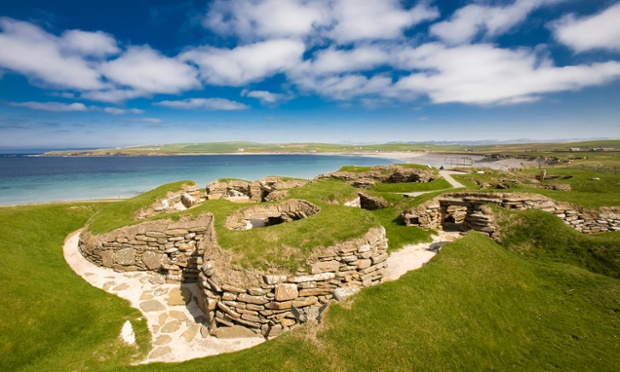
Skara Brae is a world heritage Neolithic settlement on the west coast of Mainland Island in Orkney, off the north coast of Scotland. It was discovered after a storm that revealed it in the year 1850 and is said to be 5000 years old. Skara Brae started in the the year 3180B.C. with the occupation carrying on for roughly six hundred years.

Everyday Life of Skara Brae

Skara Brae (L)_tcm4-570163

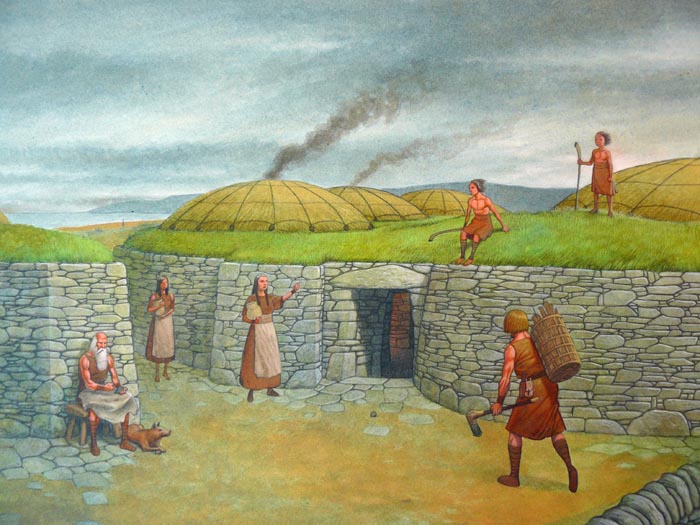
Source One: Artist’s image of daily life in Skara Brae

The people of Skara Brae lived a very straightforward stone age farming life with plenty of food to eat. They kept herd animals such as cattle and sheep as well as growing barley and wheat. They also hunted boar and red deer for their meat and skin. Seal meat was also eaten and on rare occasions they used a beached whale for food. Evidence shows that they could have eaten eggs and maybe even the birds themselves from egg shells being found.

filename-skara-brae-reconstruc

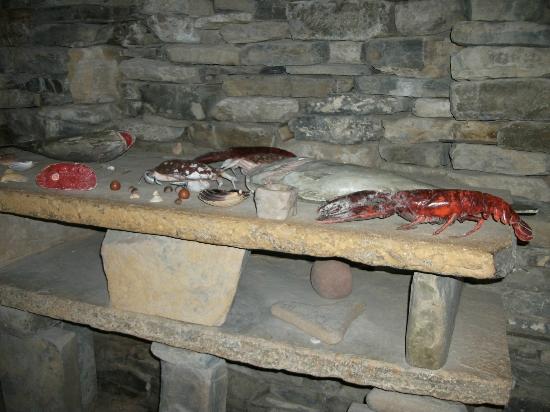
Source Two: Reconstruction of Skara Brae food and dresser.

Archaeologists have found many fish bones suggesting that fish was a common food as shown in Source Two. No fish hooks have been found and we think that the people could have used fish traps instead.

Skara Brae was a seaside village and limpet shells were a common and easy to harvest food and bait source for them. This is probably the reason why they had tanks in their huts, to soak and soften the limpets.

Because wood was limited, the villagers probably burned a combination of seaweed and dried animal dung for heating and cooking.

Many of the bone tools and appliances found in Skara Brae shows that animal skin was the most prevalent material they used. The bone came from decent sized sea animals and also herd animals.

Architectural evidence shows that the people of Skara Brae were not ruled by a leader. Every human and house in Skara Brae seemed to have equal qualities, furniture and standards.

(Source two image courtesy of TripAdvisor.)

Religion of Skara Brae

MaesHowe

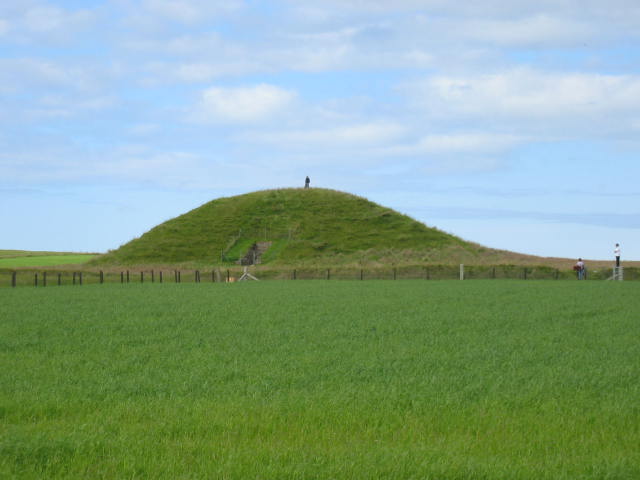
Source one: Burial cairn at Maeshowe, fifteen miles from Skara Brae

Skara Brae religion is still unknown to this day. They had no religious records because they had not developed a written language. They also have burial mounds, or cairns, so there may have been some belief in an after life. The dead were thought to be a very important part of Skara Brae due to the fact that they put so much time and effort into making the cairns. It is said that it took up to over six months to construct the largest and most used tomb. Because of this, there is a strong chance that they could have worshipped their ancestors.

The Neolithic cairns found around Skara Brae were an important part of village life and were visited regularly. Archaeologists that excavated the tombs, found that there was more than one occupant each cairn and sometimes held piles of jumbled bones from more than one body.

The design of their tombs were quite similar to the layout of the houses so maybe they thought that their spirits of the dead were still living amongst them.

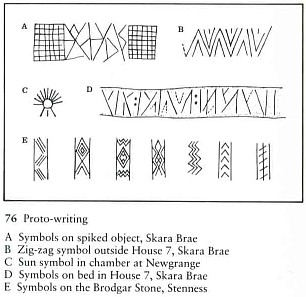
The people of Skara Brae did not leave any religious writings because they didn’t have a written language apart from basic symbols known as runes. Their religion will always be unknown to us. We can only guess that their dead was an important part of their religion.

City Layout of Skara Brae

ork08_skara-brae-map

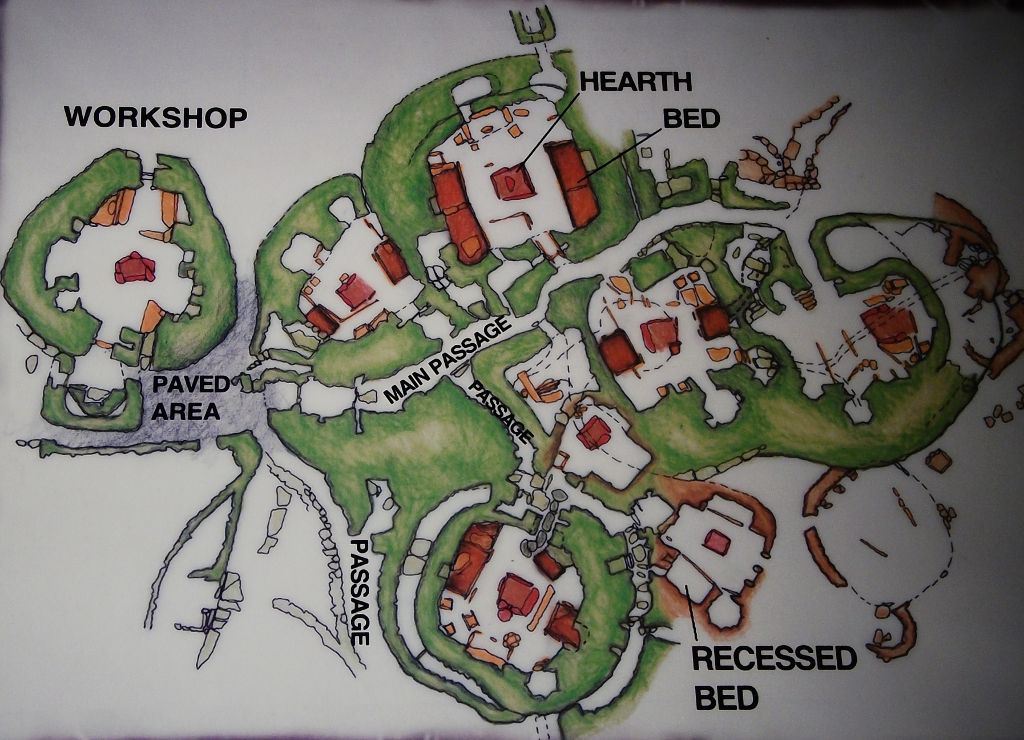
Source one: Drawing of village layout of Skara Brae, showing the passages between the sheltered huts.

Archaeologists have uncovered eight huts in Skara Brae and it is estimated that they were home to between fifty and one hundred villagers. Each hut measures between four to six meters across.

Source One shows that there were a series of paths that wove through the village. There was a main passage cutting through the centre of the village.  The village was built buried into the ground but with paths exposed to the outside world.

There are no traces of the original roofs, only the walls remain of the individual huts.

Every hut was identical except for house seven and house eight. Nobody knows why house seven was built. The door on this hut could only be opened from the outside. Perhaps it was used as a prison, or to isolate young boys or girls that were approaching puberty as part of a ceremony. Maybe it was a birthplace?

House eight was separate to the other huts in Skara Brae, and had none of the furnishings or other objects as the common hut would. Archaeologists mention that it may have been a workshop to manufacture or build tools, as they found flint and other stone debris.

Another theory for why house eight was built is that it could have been a meeting house for the public, as there were many carved stone decorations.

1382790_s-hdr3

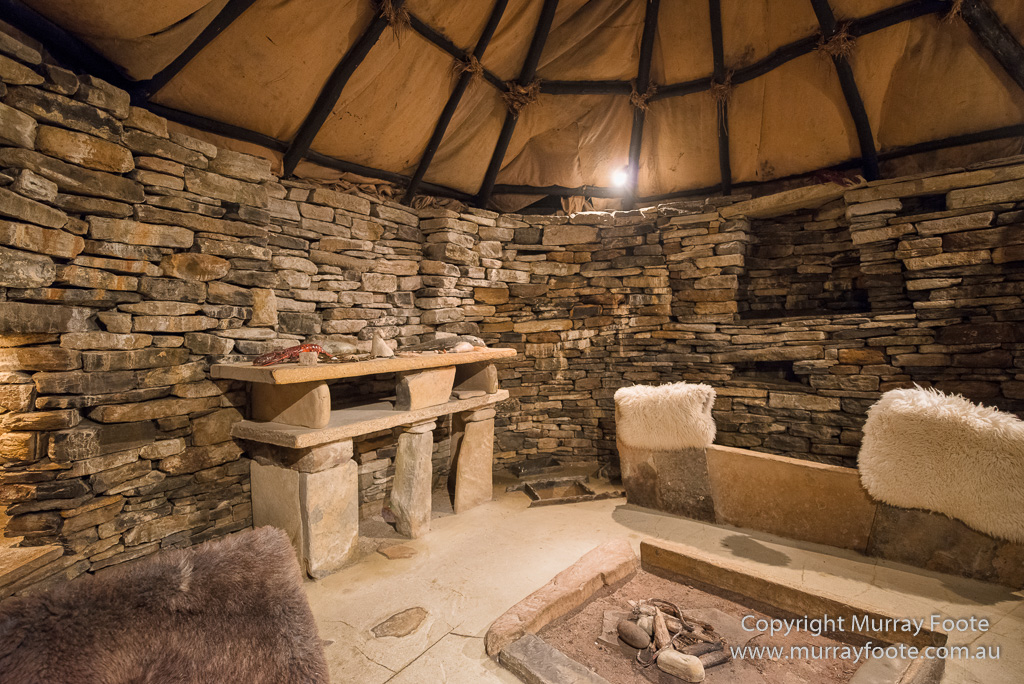
Source Two: Inside of one of the common huts built into the ground, showing the central hearth.

Apart from hut seven and eight, there was an identical layout to every house with there being a central hearth, a dresser, limpet box and two beds either side. 

There were two beds in each hut with one being larger than the other. Archaeologists say that the larger bed was built for the men, from finding jewellery and other feminine objects under the smaller bed.

With all houses in Skara Brae having been built into the landscape and having no windows, it was quite dark inside, which was the main reason why they had a fire place in the centre of the hut, to provide heat and light.

Because of the shortage of timber on the Orkney Islands, the people of Skara Brae used whale bone or drift wood as the frame for the roofs, covered with skins, then weighed down with earth.

There was a small chimney being a hole at the top of every hut for smoke to flow out from the central hearth.

Because there are no trees around Skara Brae, most of the furniture, houses and passage ways were built out of stone as shown in Source Two.
 

Art of Skara Brae

skara_brae_art

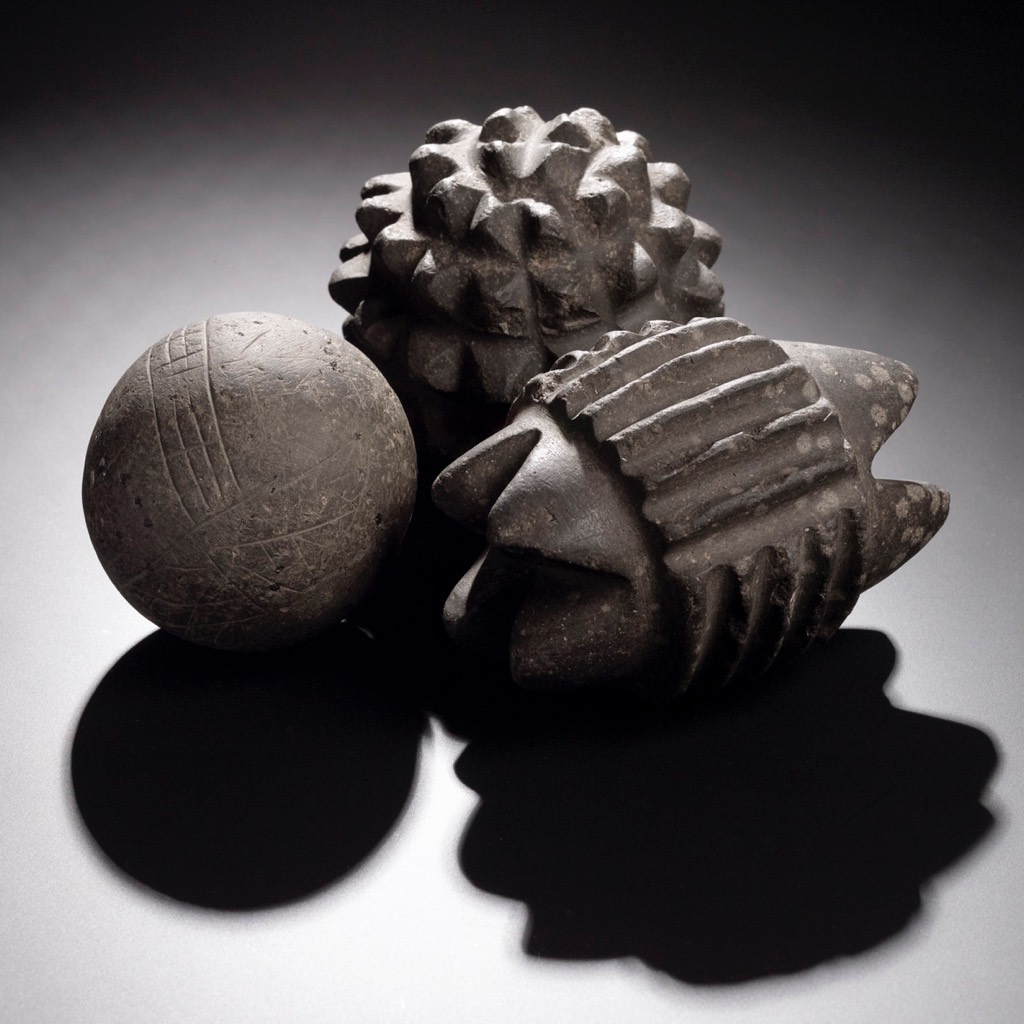
Source One: Carved Stone Balls found at Skara Brae

Archaeologists have found carved stone balls, roughly the size of a child’s hand, at Skara Brae. To carve these balls it took time and hard work because the people of Skara Brae didn’t have metal tools.

Archaeologists aren’t one-hundred percent sure what these balls are used for. Theories about their possible uses include as a throwing weapon, for games or sport, as weights for fishing nets or as symbols of a person’s importance. One theory is that they may have been a ‘speaking ball’, giving the holder the right to speak in village meetings.

Similar stone balls were also found around the Boyne Valley in Ireland, six hundred kilometres away.

The same symbols found carved on the balls, have also been found elsewhere in Skara Brae, carved on door frames and bed posts, pottery and walls.

Skara_Brae_symbols1 (1)These symbols, as shown in the diagram above, are a form of  runic writing, that is, primitive writing from before the creation of an alphabet. No-one has been able to decipher what these primitive symbols mean.
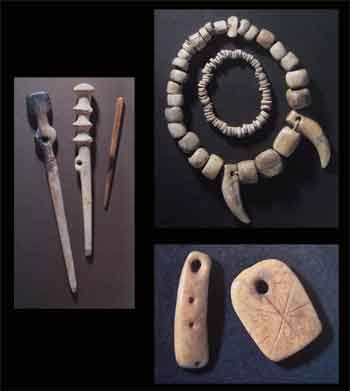

skarabrae_jewellery

Source Two: Bone Pins, Necklaces and Amulets from Skara Brae

Three types of jewellery have been found at Skara Brae — beads, pendants and pins. Most of the jewellery was made from bone that came from decent-sized sea animals and also herd animals. The pins were used to fasten their clothes and to keep up their long hair. Some of the hair pins are up to 35 centimetres long.

Some of the jewellery was carved with decorations and there is evidence that the men wore jewellery.

Bibliography

http://www.orkneyjar.com/history/skarabrae/layout.htm

http://www.orkneyjar.com/history/skarabrae/religion.htm

http://www.odysseyadventures.ca/articles/skarabrae/skarabrae_article.htm

http://teachinghistory100.org/objects/for_the_classroom/carved_stone_ball_from_skara_brae

https://en.wikipedia.org/wiki/Skara_Brae

http://www.odysseyadventures.ca/articles/skarabrae/skarabrae_article.htm

http://www.odysseyadventures.ca/articles/skarabrae/skarabrae_article.htm

http://www.bbc.co.uk/scotland/learning/primary/skarabrae/content/people/evidence5.shtml

http://www.orkneyjar.com/history/skarabrae/skarab2.htm

http://www.orkneyjar.com/history/skarabrae/religion.htm

watercolourclub.wordpress.com

http://www.tripadvisor.co.uk/LocationPhotoDirectLink-g7255234-d1942863-i65642331-Explore_Orkney_Tours-Finstown_Mainland_Orkney_Islands_Scotland.html#last