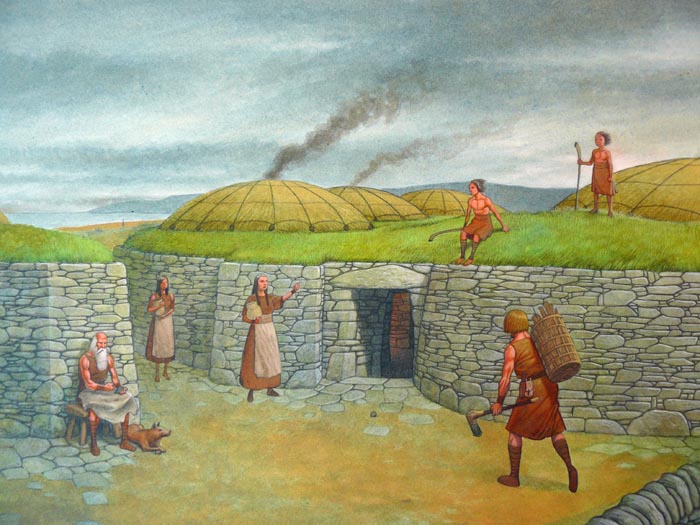
Source One: Artist’s image of daily life in Skara Brae
The people of Skara Brae lived a very straightforward stone age farming life with plenty of food to eat. They kept herd animals such as cattle and sheep as well as growing barley and wheat. They also hunted boar and red deer for their meat and skin. Seal meat was also eaten and on rare occasions they used a beached whale for food. Evidence shows that they could have eaten eggs and maybe even the birds themselves from egg shells being found.
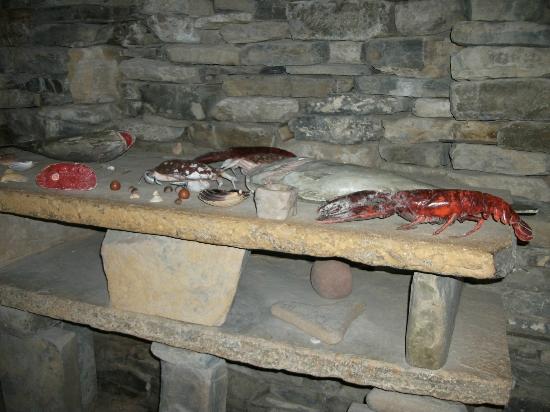
Source Two: Reconstruction of Skara Brae food and dresser.
Archaeologists have found many fish bones suggesting that fish was a common food as shown in Source Two. No fish hooks have been found and we think that the people could have used fish traps instead.
Skara Brae was a seaside village and limpet shells were a common and easy to harvest food and bait source for them. This is probably the reason why they had tanks in their huts, to soak and soften the limpets.
Because wood was limited, the villagers probably burned a combination of seaweed and dried animal dung for heating and cooking.
Many of the bone tools and appliances found in Skara Brae shows that animal skin was the most prevalent material they used. The bone came from decent sized sea animals and also herd animals.
Architectural evidence shows that the people of Skara Brae were not ruled by a leader. Every human and house in Skara Brae seemed to have equal qualities, furniture and standards.
(Source two image courtesy of TripAdvisor.)